

This is the first of three supplemental pieces to my Fiscal Year 2026-2027 Central Pines Regional Council Recommended Budget Message. These supplemental documents allow a deeper dive into three of the most pressing issues facing the organization over the next several years. Each piece will end with recommendations to the Board on how to address the issue over the coming year(s).
Executive Summary
Demand for Long-Term Care Ombudsman services in the Central Pines region continues to grow, while federal and state funding has failed to keep pace. Since 2013, the number of licensed long-term care beds in our region has increased by nearly 900, yet current state and federal funding supports only three of the five Ombudsman positions on the Central Pines staff—well below nationally recognized staffing standards. County governments in the Central Pines Region have voluntarily filled this gap for more than a decade, but this approach is not sustainable.
To address this issue, a strategy within CPRC’s new Strategic Plan is to prioritize aging program funding consideration through regular strategic discussions with county leaders, intensify state and federal advocacy for increased Ombudsman funding, and evaluate limited interim options—including regional funding strategies—while reinforcing that this gap is ultimately a state and federal responsibility.
Background
One of Central Pines’ most significant long-term funding challenges is the growing gap between the demand for Long-Term Care Ombudsman services and the resources available to deliver them. This is not new, but it is increasingly urgent as our region’s long-term care facilities and bed counts expand.
Since 2013, the number of licensed long-term care beds in the Central Pines Region has increased by 6.9%, an additional 896 beds across nursing homes, adult care homes, and family care homes in our seven-county region. Today, our Ombudsmen are responsible for advocating on behalf of almost 900 additional residents with no commensurate increase in state or federal funding to support the need for additional staff. Our Ombudsmen are doing exceptional work under conditions that exceed what national standards consider adequate.
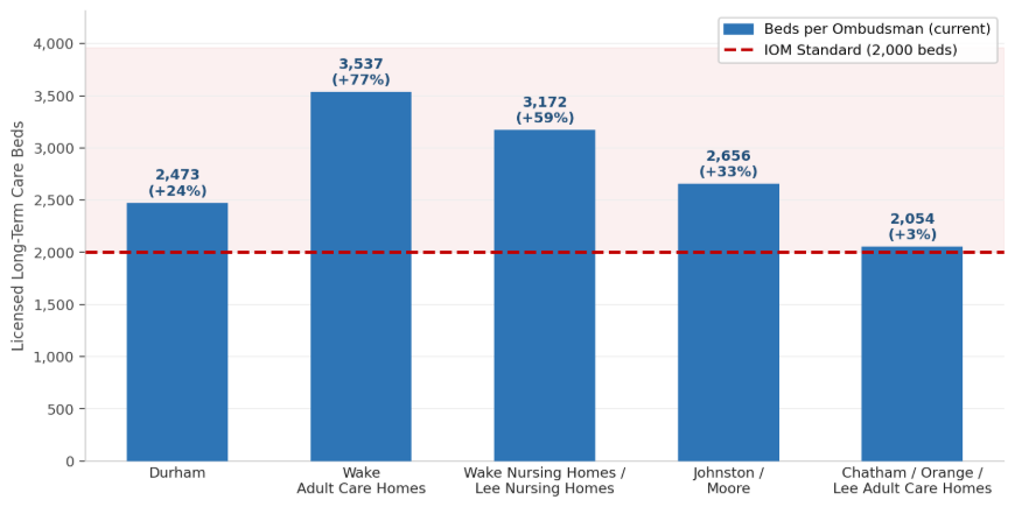
The Institute of Medicine recommends one full-time Ombudsman per 2,000 long-term care beds, a benchmark cited consistently by the U.S. Government Accountability Office, AARP, and North Carolina advocacy organizations.
At full current staffing, we fall two positions short of the nationally recognized standard. When the standard is applied to the 13,892 licensed beds in the Central Pines region, the Regional Council needs seven (7) Ombudsmen. However, Central Pines has had five (5) for a number of years. State and federal funding covers only about three (3) of those positions; our county governments generously fund the remainder.
This is not a sustainable trajectory. As the region continues to grow, the gap between what the program needs and receives will only widen. Over the coming year, CPRC will convene our county partners for a candid conversation about how to address this funding shortfall. Options to consider may include increased county investment, advocacy at the state and federal level for reauthorization with increased funding, improved funding formulas, or some combination of both. What is clear is that the current model cannot continue to deliver adequate advocacy and protection for long-term care residents without additional resources.
The chart below illustrates the current workload of Central Pines’ five Ombudsmen, measured against the IOM standard of 2,000 beds per position. All Ombudsmen on our team exceed the national standard — some by a significant margin:
This challenge aligns directly with our new Strategic Plan's vision for Central Pines as a regional innovation hub for effective, person-centered human services. The Ombudsman funding gap is exactly the kind of structural regional issue that requires CPRC's unique convening and advocacy role.
Our Strategic Plan addresses this through Strategic Focus Area 1 (Thriving People and Communities), Goal 1, Strategy b: convening county managers, CPRC Delegates, CPRC Leadership, and AAA Leadership biannually for education, coordination, and State Aging Plan implementation updates.
The Cost of Inaction: A Funding Gap Years in the Making
The financial picture behind our Ombudsman program illustrates precisely why advocacy at the state and federal level must intensify — and why Central Pines county government members deserve recognition.
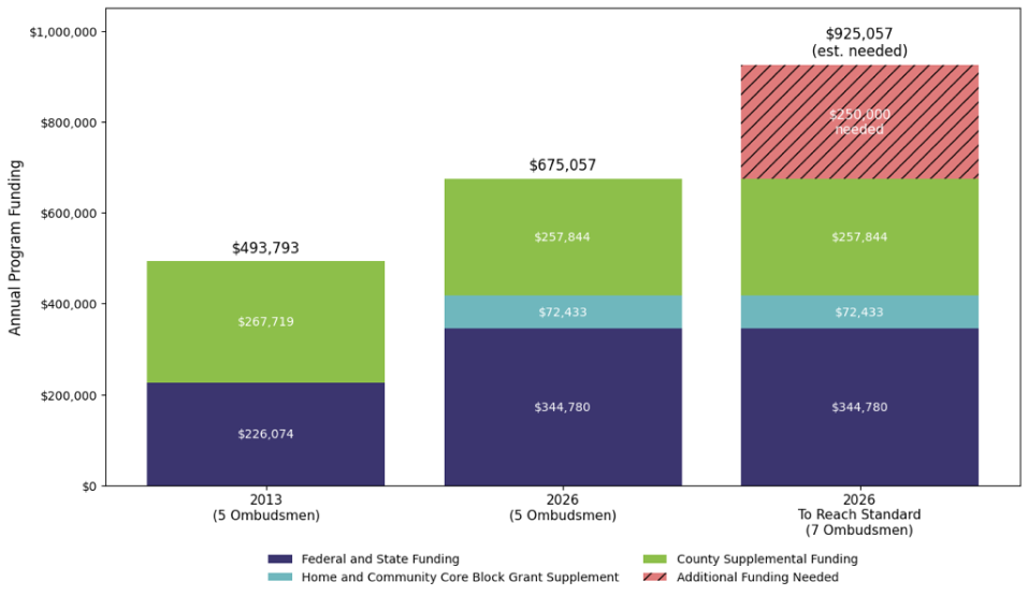
In 2013, the total cost of Central Pines five-person Ombudsman program was $493,793, with $226,074 in federal and state funding and $267,719 in county funding. That county investment was not an obligation, but a choice that reflects the values of our county governments and their commitment to some of the most vulnerable residents in our region.
Today, federal and state funding totals $417,213, an increase of $191,139. Direct Federal and State funding has increased by $118,706 over 13 years, but that falls far short of inflation and the increase in bed counts. Our counties have continued to supplement the program at essentially the same level — $257,844 today compared to $267,719 in 2013.
So, how is the increased gap being funded if direct federal and state funding is not keeping pace? To lessen the direct burden on our counties and maintain service levels as much as possible, CPRC has begun using Home and Community Care Block Grant funds to keep the Ombudsman count at five. While this keeps Ombudsman staffing stable, taking funds from Home and Community Care Block Grant means less funding for our counties' other aging service providers.
It is worth noting that our counties are doing something that many of their peers across North Carolina are not. Across other regions in the state, county supplemental funding for the Ombudsman program is far less common. Our county partners have been quietly filling a gap that is not theirs to fill — and the residents of our long-term care facilities are better protected because of it.
The gap is not a county problem. It is a federal and state funding issue. An estimated additional $250,000 in annual funding is needed to reach the IOM standard. That funding should come from the state and federal government — and CPRC will be an active and persistent advocate for that investment through our federal legislative agenda, our engagement with the NC Division of Aging and Adult Services, and our participation in statewide advocacy efforts.
Our Need for More Ombudsmen Will Accelerate
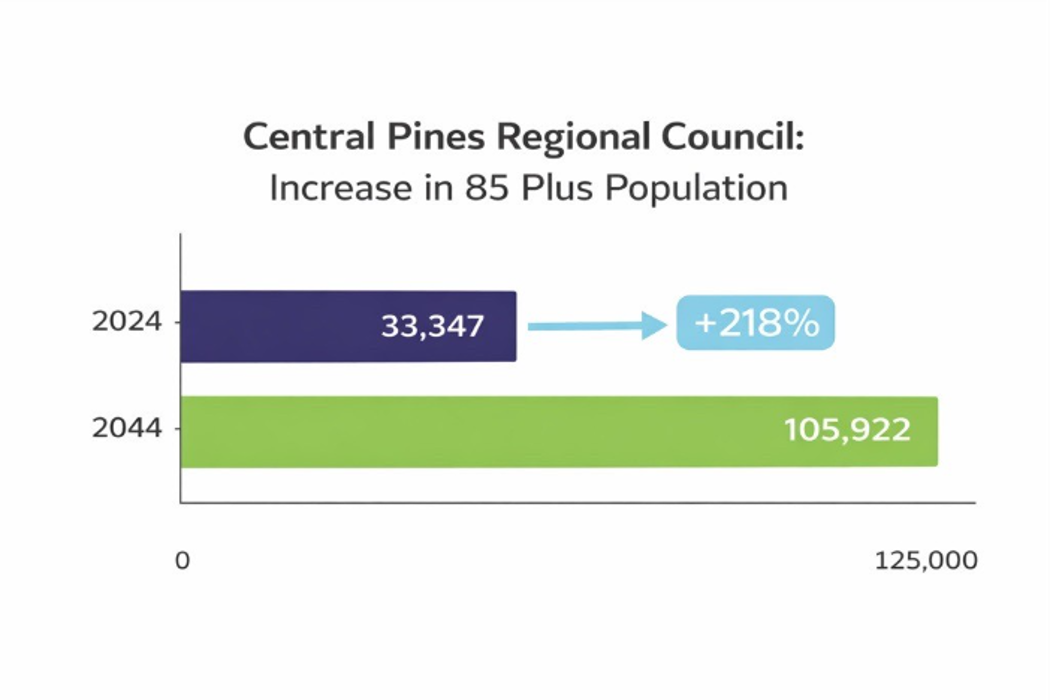
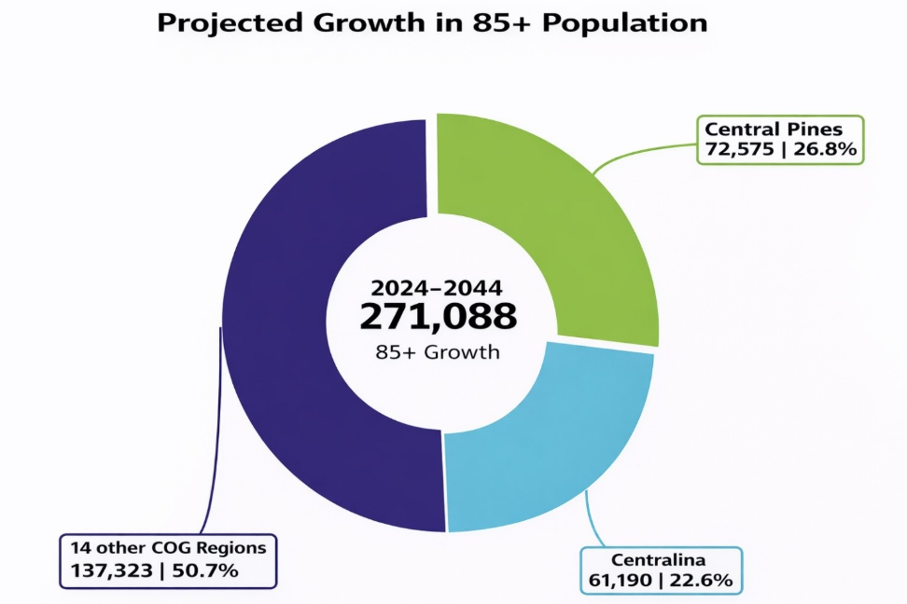
It is no secret that the Triangle region is growing rapidly, but let's focus on the demographics that signal an expected significant increase in the region’s long-term care bed count: individuals 85 years of age and older. Currently, 33,347 individuals 85 years and older live in our region. The North Carolina Department of Health and Human Services Aging Profile predicts an Age 85+ population in the Central Pines region of 105,922 by 2044, a 218% increase, or 72,575 more individuals over age 85. Let’s put that into some perspective. Our 85+ population in 2044 will be about as large as the current population of Apex, the region’s fourth largest municipality. Only the Cape Fear region will grow at a larger percentage (296%), but its increase will be 33,286 individuals over 85, versus our region's 72,575.
What does this mean for Ombudsman Staffing Levels?
Is it logical to correlate our region’s percentage increase in individuals 85+ with the number of long-term care beds in the region (an increase from 13,892 to 30,284 or a 218% increase in beds)? There is no direct correlation between the two, but I think one could conservatively conclude that the region may see a doubling of long-term care beds between now and 2044 to accommodate a 218% growth rate. The result of doubling long-term care beds is a total of 27,784 in the region. When you apply the 2,000 beds per Ombudsman staffing standard, the region may need 14 Ombudsman by 2044, an increase of nine (9) Ombudsman positions. This means that, to keep pace, Central Pines needs to begin considering adding an Ombudsman at least every other year.
Recommendations
The proposed Central Pines Strategic Plan lists as one of its strategies that Central Pines staff, County Managers, and our County Delegates should gather at least semiannually to discuss issues within the aging programs. Following the anticipated adoption of the Strategic Plan in April, we will begin working with our County government members to schedule the first meeting sometime in the Summer of 2026.
Funding of aging programs across our region should be a top priority of these discussions. Options to close the funding gap for the Ombudsman are limited, but there are ways to secure additional funding. These include:
1) Continued lobbying to the State and Federal governments for increased funding for Aging Services. The North Carolina Association of Regional Councils has had increased funding for the Ombudsman program on its legislative agenda, but to make this more urgent, I would recommend that our counties jointly submit a legislative goal request to the North Carolina Association of County Commissioners for additional Ombudsman Funding.
2) Formally decide that alternate funding of the Ombudsman program will come from the Home and Community Care Block Grant. Central Pines had shied away from doing this until last year. The impact of using Home and Community Block Grant funds to supplement the Ombudsman program is reduced funding for service providers, even as waiting lists and needs are already sizable.
3) Central Pines Counties have been very generous in providing a share to the Area Agency on Aging over the years, recognizing that state and federal funds are not sufficient to fund aging programs. Increases to the aging share could address the needs, but they would also increase the program supplement, which should be funded at the state and federal levels.